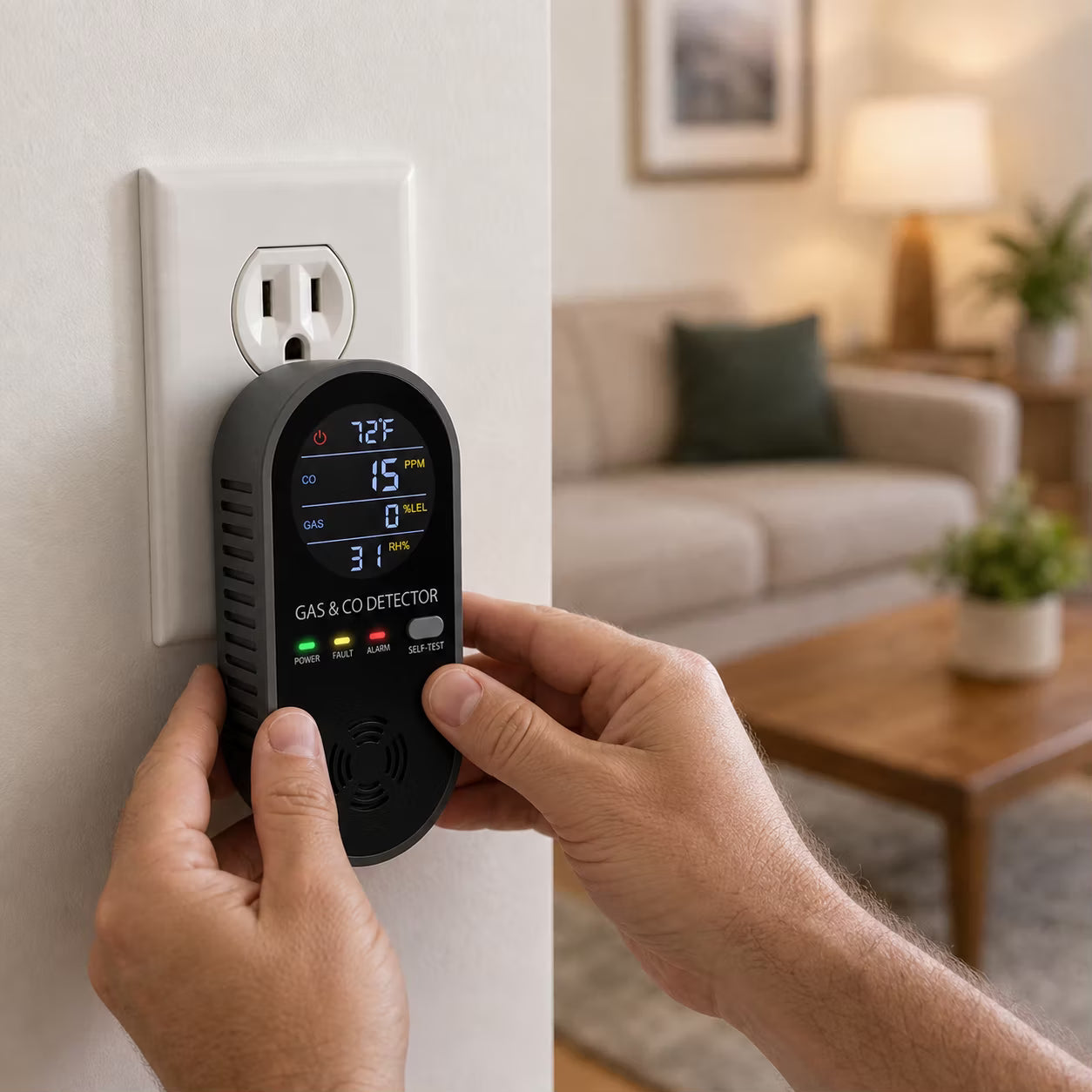
01 — PLUG IN
Any US outlet. 30 seconds.
Standard NEMA 5-15. No tools, no wiring, no batteries to swap. The unit starts reading the room the moment you plug it.

Aegis Home Safe is a real-time CO + combustible gas monitor that shows what basic alarms hide — live PPM, %LEL, temperature and humidity from any outlet.
Plug-in only — no internal battery. Keep your code-required CO alarm active for power-outage protection. Aegis Home Safe adds live visibility; it doesn't replace code-required alarms.
U.S. ER visits for non-fire CO exposure.
U.S. deaths from unintentional, non-fire CO poisoning.
The threshold a basic alarm is tested to sound at — within 60–240 min.
The reading we show on the LCD — long before symptoms arrive.
Sources: CDC carbon-monoxide overview · CPSC CO alarm conformance phase I report.


Built like an instrument, not a gadget. The LCD shows live CO, gas, temperature and humidity readings at the outlet.
Standard NEMA 5-15. No tools, no wiring, no batteries to swap. The unit starts reading the room the moment you plug it.
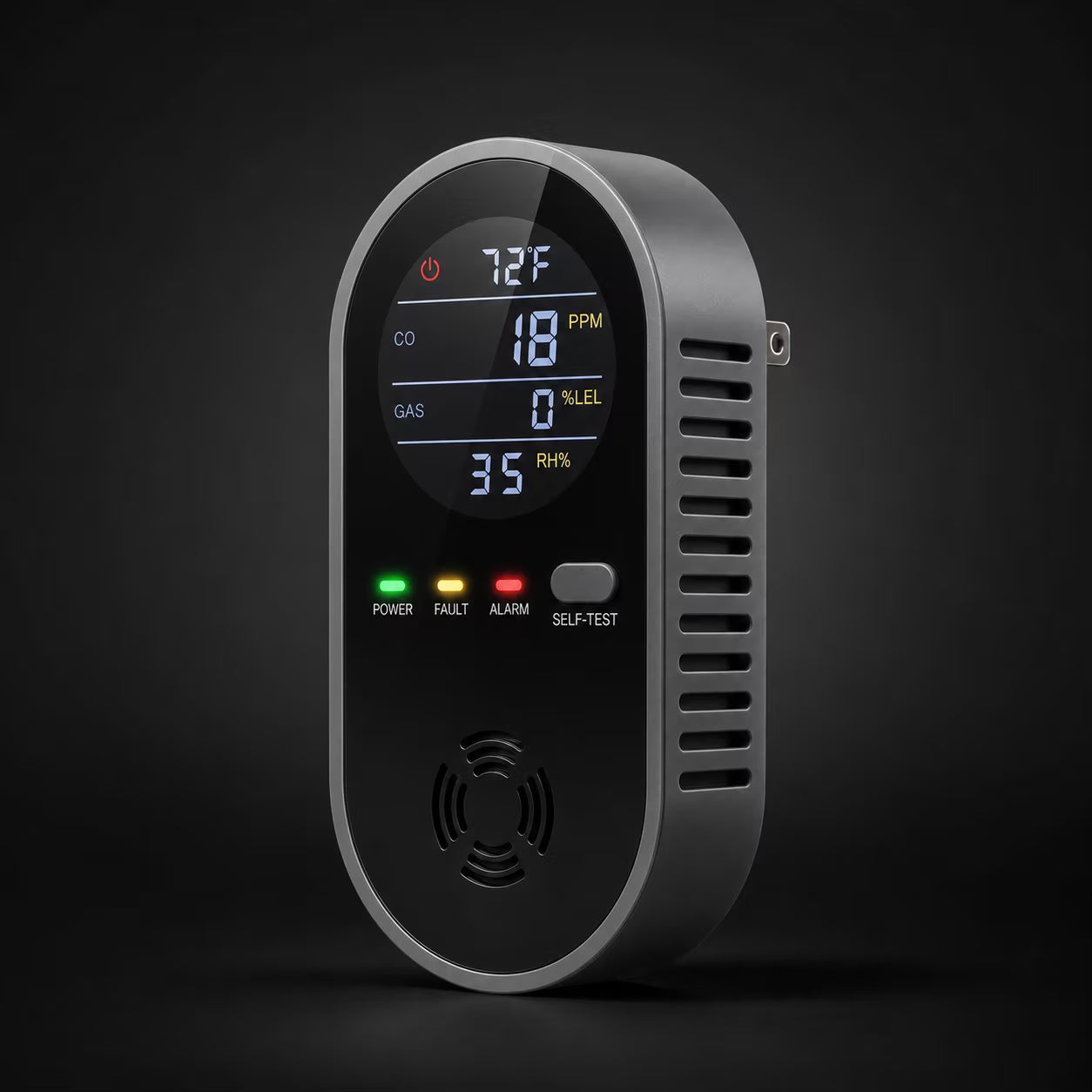
The LCD shows every reading 24/7 with three status LEDs and a hardware self-test. If a value drifts, you'll see it before you'd ever feel it.
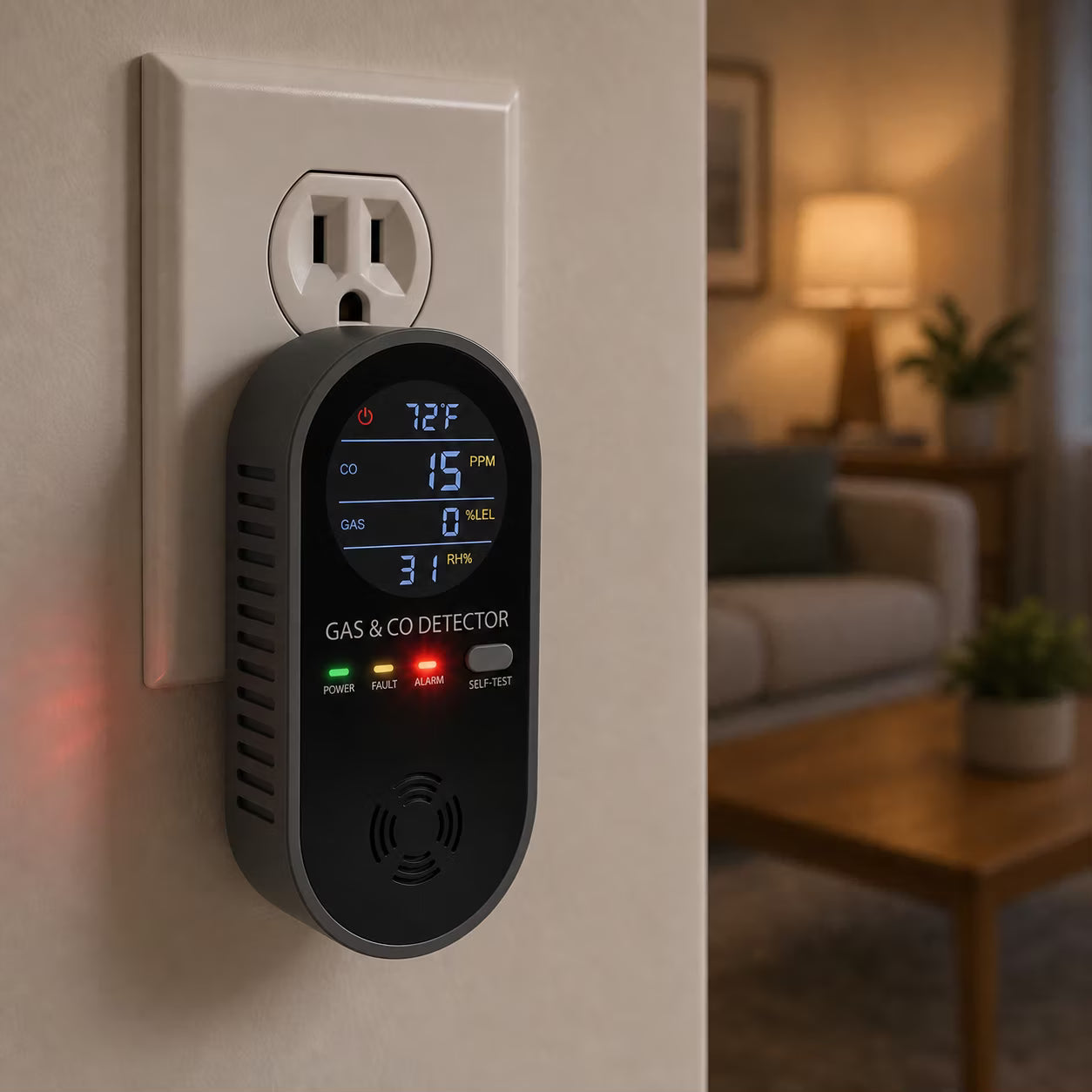
Low-level readings are visible on the LCD. Audible alarms follow UL2034 thresholds; keep your code-required CO alarms active.
Most UL-listed CO alarms are tested to sound at 70 PPM within 60–240 minutes. At 150 PPM that window narrows to 10–50 minutes. They do their job well — but that job is "scream at danger," not "show drift."
Aegis Home Safe is built differently. It shows the number from 10 PPM and up, so you see CO climb before symptoms do. Your existing alarm stays. This adds the picture it was never asked to draw.
Drag the marker. See which standards apply at each PPM — and how long a UL2034 alarm is allowed to wait.
Sources: EPA NAAQS · EPA IAQ · OSHA Chemical Sampling 462 · NIOSH · UL2034 alarm test windows (CPSC).
A hallway reading isn't a full-home picture. Your specific risk depends on layout and appliances.
Turns out my stove was lit wrong. Old alarm never said a word. I would have never known.
She has a battery alarm but her furnace is old. Now I can call her if the PPM gets weird overnight.
Cabin in the winter, RV in the summer. The %LEL line on propane is what sold me.
Knock one star for that. Otherwise the readout is honestly addictive. I check it like a thermostat.
Looks like a thoughtful piece of hardware, not a smoke-alarm afterthought.
Ended up with the 3-pack. Kitchen, hallway outside the bedrooms, one near the furnace. I sleep better.
Smoke alarms detect particulate from fire. CO and combustible gas are invisible and odorless. Keep your smoke alarm. Aegis is a separate, real-time monitor for CO, natural gas, and propane.
Yes. The catalytic sensor reports combustible gas as a percentage of LEL (lower explosive limit) for both natural gas (methane) and propane.
Aegis is plug-in only — no internal battery. During an outage it does not protect. Keep your code-required battery-backed CO alarm active. Aegis adds live visibility while powered.
Aegis Home Safe is ETL listed to UL2034 and UL1484. Keep your code-required CO alarms active; Aegis adds live visibility.
CPSC recommends a CO alarm on every level and outside sleeping areas. Use the Room Calculator above for a layout-specific recommendation. Most full-home owners land on the 3- or 6-pack.
The audible alarm activates at UL2034 thresholds — not at low PPM. Pre-alerts at lower readings are visual only. The hardware self-test confirms the sensor and speaker each time you press it.
10 ppm is information — your home is showing some CO from somewhere. 70 ppm is the UL2034 threshold where alarms are required to begin sounding within 60–240 minutes. Above 70 ppm, or any symptoms, is a leave-the-home situation.
Yes. Building codes in most U.S. jurisdictions require battery-backed CO alarms in specific locations. Aegis is designed to add visibility, not to replace code-required alarms.
CPSC guidance: on every level and outside sleeping areas. Avoid spots within 5 feet of cooking appliances or right next to bathrooms (humidity). The Room Calculator suggests outlets based on your layout.
Yes. The 365-day test drive lets you return it for a full refund within a year if it does not earn its outlet. Shipping back is on us.
Most U.S. CO incidents happen between November and February when furnaces run all night. The visibility you want is the visibility you wish you'd had.
If your CO alarm sounds or you experience headache, dizziness, nausea, or confusion - leave the home immediately and call 911. Aegis Home Safe does not replace emergency response.
